Case Study: Cactus Cave Cardiology Increases Revenue by 12.7% with HybridChart
EXECUTIVE SUMMARY
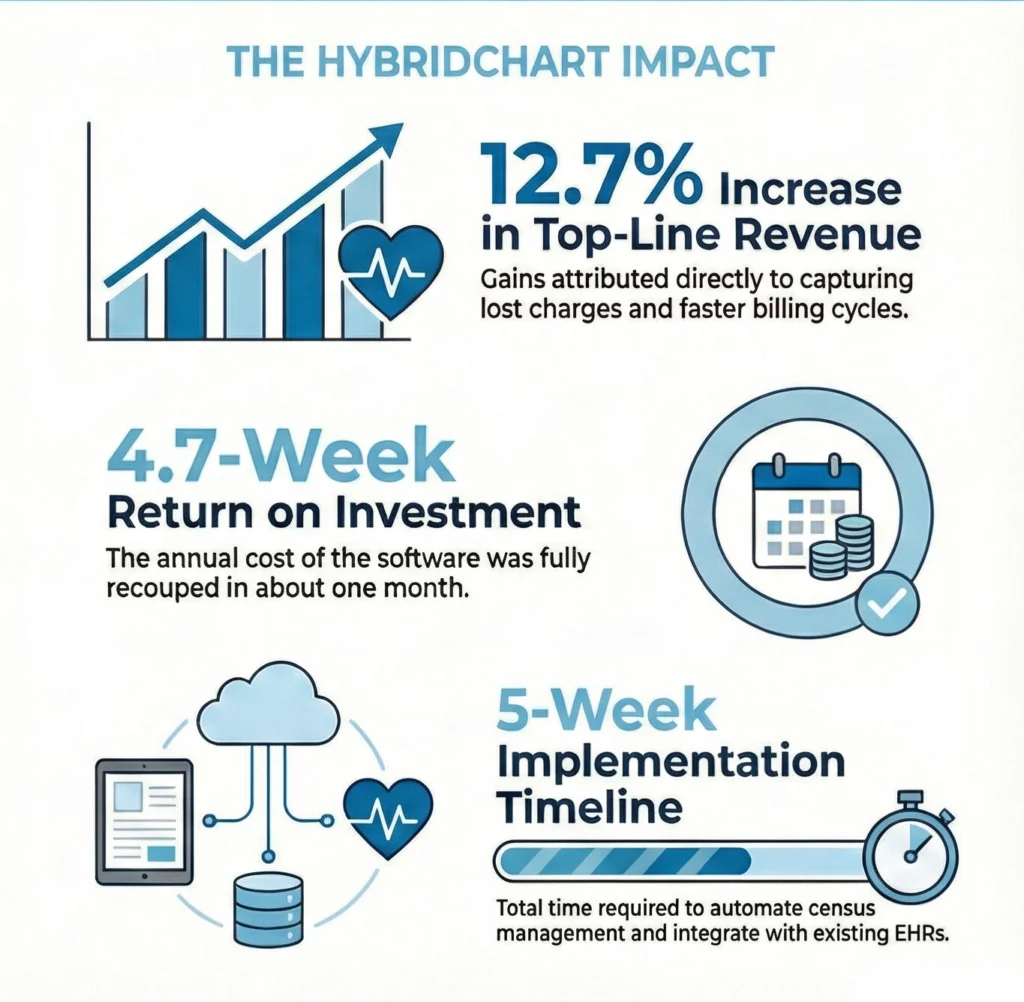
Cactus Cave Cardiology, a stand-in Cardiology practice for a very real, but anonymous client of HybridChart’s, is a busy dual-location practice, facing significant revenue leakage due to outdated paper-based charge capture methods. By implementing HybridChart’s leading mobile charge capture solution, the practice eliminated lost charges and optimized their revenue cycle. The result was a 12.7% increase in revenue and a full return on investment in just 4.7 weeks.
CUSTOMER PROFILE
Cactus Cave Cardiology is a high-volume specialist practice located in the Southwest. Their team operates out of two offices on opposite sides of a major metropolitan area. Additionally, their physicians hold rounding rights at four different hospitals, requiring constant travel and coordination across multiple facilities, and all jointly syncing back to their practice management software and EHR.
THE CHALLENGE
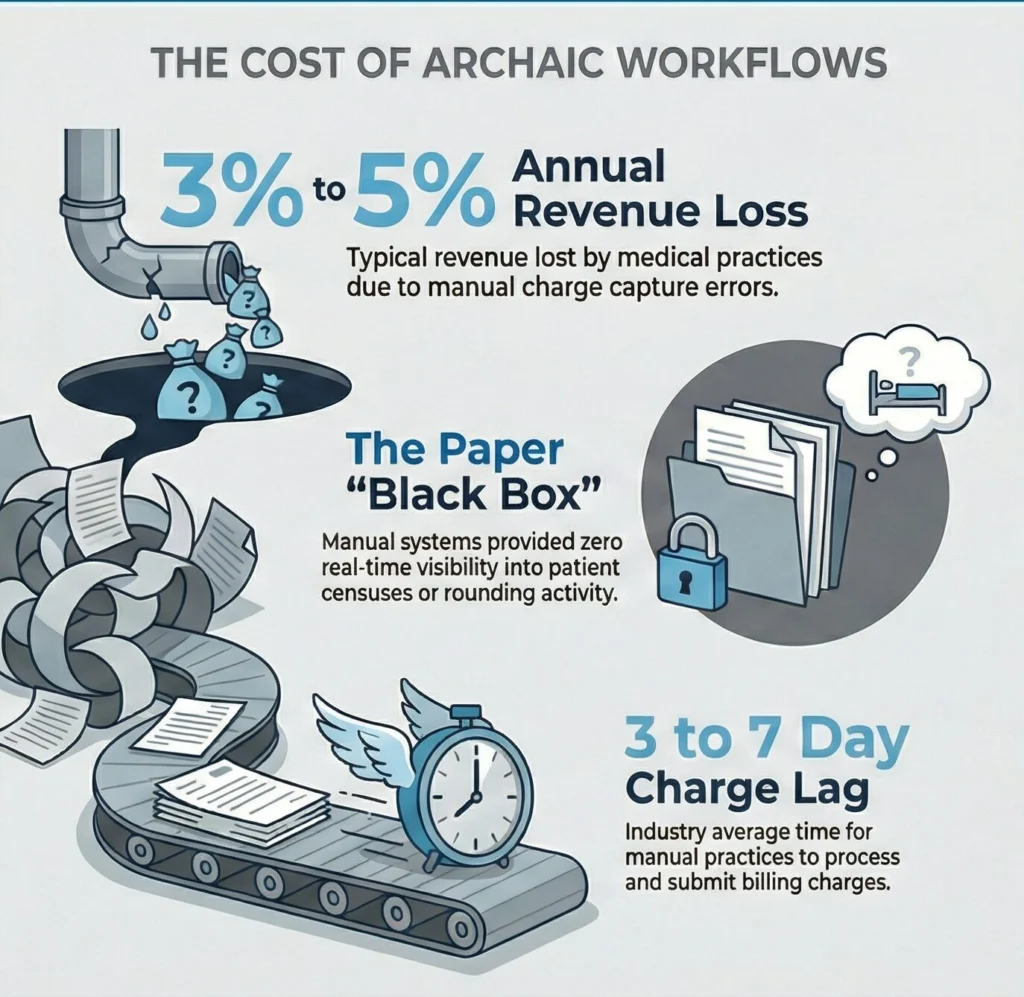
The practice has historically relied on a manual, paper-based system to capture charges. Old habits die hard with doctors typically batching their charges at the end of a long shift or wait until “office hours” at the end of the week to submit them. This process created a “black box” for the Revenue Cycle Management (RCM) team, who had no real-time visibility into patient censuses or daily rounding activity.
After an internal audit, the practice realized the consequences of their archaic methods were severe enough to look to a more modern and automated process. Publicly available healthcare statistics indicate that medical practices lose between 3% and 5% of their annual revenue due to charge capture errors (Zotec Partners). For Cactus Cave, this manifested as lost charges, significant lag times in processing, and frequent claim rejections due to delayed entry. The team knew they needed to modernize their workflow to stop this revenue hemorrhage.
THE SOLUTION
Cactus Cave Cardiology selected HybridChart to automate and modernize their charge capture process. They chose HybridChart over competitors because it was founded by a practicing cardiologist, Dr. Gregory Sanders. The leadership team felt the user interface intuitively mirrored a doctor’s actual rounding workflow rather than a generic data entry form built by coders who do not truly know how doctors work.
The onboarding process took 5 weeks, with an additional 5 weeks for the practice to achieve full user adoption across all providers. The solution included the integration of ADT (Admission, Discharge, Transfer) feeds, which automated Census Management and ensured no patient was missed during rounds. The software integrated directly with their existing Electronic Health Record (EHR) and billing systems, creating a seamless flow of data from the hospital bedside to the billing office.
THE RESULTS
The transition to HybridChart produced immediate and measurable financial improvements, validating the decision to move away from paper.
The practice realized a 12.7% increase in top-line revenue within the first year, attributed directly to the capture of previously lost charges and faster billing cycles. The annual cost of the software was fully recouped in just 4.7 weeks. Charge lag time, with industry averages often exceeding 3 to 7 days for manual practices, was reduced to near real-time submission.
The RCM team reported a drastic reduction in administrative burden. The ease of reconciling charges against the automated census reduced errors and cut down on the back-and-forth communication previously required to clarify handwritten notes. The friction between providers and billers was effectively eliminated.
CONCLUSION
Cactus Cave Cardiology proved that modernizing charge capture is not just an operational convenience, but a critical financial strategy. By switching to HybridChart, they stopped revenue leakage and improved their team’s efficiencies, resulting in more time at the point of care.

About HybridChart
HybridChart is a leading provider of mobile charge capture and hospital rounding solutions, designed by physicians for physicians. The platform focuses on eliminating the administrative inefficiencies that lead to lost revenue and provider burnout. By streamlining the workflow between medical providers and billing teams, HybridChart ensures that every interaction is captured, coded, and billed accurately.
Frequently Asked Questions
- How does HybridChart reduce lost charges?
HybridChart uses automated census management and intuitive mobile workflows to ensure providers capture charges at the point of care. This prevents the common issue of forgetting to bill for a patient seen during a busy rounding shift. - Does HybridChart integrate with my current EHR?
HybridChart integrates with most major EHR and billing systems, allowing for a bi-directional flow of data that reduces double entry and manual errors. - How long does implementation take?
As seen in the case study, a typical implementation can be completed in about 5 weeks, with full adoption following shortly after, depending on the size and complexity of the practice. - Is the platform secure?
HybridChart is fully HIPAA-compliant and utilizes enterprise-grade security protocols to protect sensitive patient data (PHI). - Can HybridChart help with discharge planning?
The platform includes features for discharge management, allowing teams to coordinate effectively and reduce the length of stay, which is critical for value-based care models.
