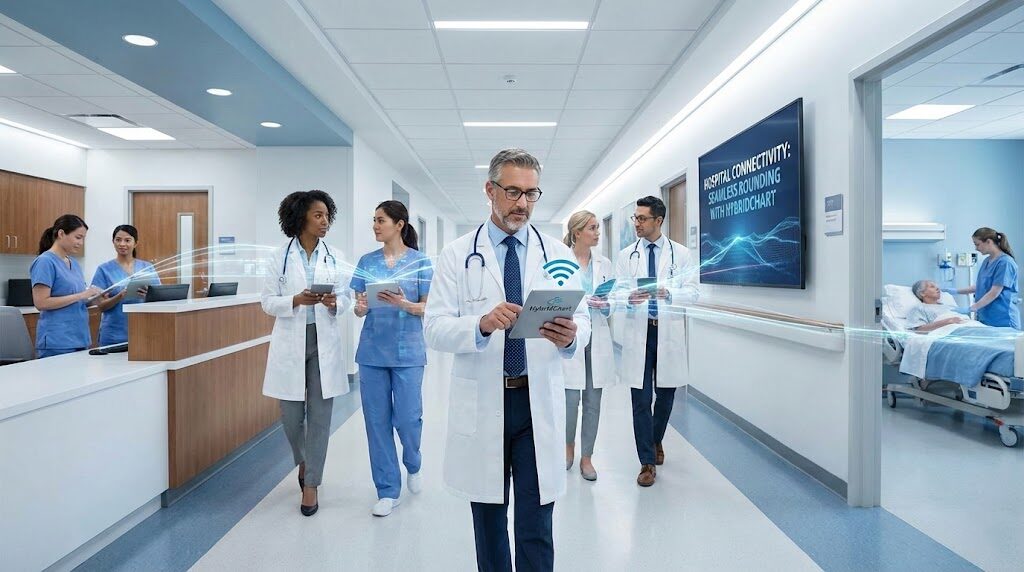
It’s a tale of two worlds in a fragmented healthcare ecosystem.
In one world—your medical office—everything is structured. You have your Electronic Health Record (EHR), your practice management software, your schedule, and your staff. It is a controlled environment.
In the other world—the hospital, the nursing home, the rehab center—it is the “Wild West.”
Every facility uses a different EHR. None of them talk to each other, and certainly none of them talk to your office. When a doctor leaves the four walls of their practice to round, they are stepping into a fragmented data landscape where mistakes happen and patients get lost.
At HybridChart, we the fragmented healthcare ecosystem by not trying to replace the hospital systems, but by sitting on top of them. We call this the “Thin Veneer” strategy.
Weaving Together the Digital Landscape
The problem with most interoperability solutions is that they are heavy, expensive, and slow.
Dr. Greg Sanders, HybridChart’s founder, visualized a different approach:
“HybridChart is a thin veneer that sits on top of all the facilities that you round at. It offers a common way, with a common process, regardless of what facility you are in.”
Whether your providers are at a large university hospital, a small rural center, or an ambulatory surgical center, their interface remains exactly the same. We absorb the complexity of the underlying systems so the doctor doesn’t have to.
The Technical Challenge: “Push” and “Pull”
True connectivity isn’t just about sending a bill. It requires a bi-directional flow of data to weave the digital landscape together.
1. The Pull: Hospital Feeds (ADT)
The biggest friction point for rounding doctors is manual entry. Typing in patient names, dates of birth, and insurance numbers is a waste of high-value clinical time.
We have developed turnkey connections to absorb Admission, Discharge, and Transfer (ADT) feeds from hospitals.
-
The Challenge: Getting a feed from a hospital usually takes months or years of IT bureaucracy.
-
The Solution: We have created a proprietary method to establish these connections quickly. As Dr. Sanders notes, “Getting a feed can’t take years. It needs to take weeks.”
-
The Result: Patient lists populate automatically. Insurance data is accurate. The doctor just shows up and rounds.
2. The Push: EHR Integration
Once the work is done, the data must flow back to the office. We connect to all major EHRs (Epic, Cerner, Athena, etc.) to push charges, notes, and discharge instructions directly into your central system.
Eliminating Data Silos for the RCM Team
Connectivity isn’t just for the doctors; it is vital for the Revenue Cycle Management (RCM) team.
Without integration, RCM teams are blind. They don’t know who is in the hospital until a piece of paper lands on their desk. With HybridChart’s ecosystem:
-
Real-time Visibility: The RCM team sees the “feed” of data as it happens.
-
Gap Analysis: They can compare the hospital census against the charges received to identify missed billing opportunities immediately.
-
Claim Management: Charges flow directly into the practice management software, eliminating manual typing errors.
Conclusion: Solving the Interoperability Crisis
You cannot fix the American healthcare system’s fragmentation overnight, but you can insulate your practice from it.
By implementing a platform that connects the dots—weaving together hospital feeds, mobile providers, and office EHRs—you create a seamless workflow in a disconnected world.
“This is weaving together the digital landscape of what healthcare has become, which is traditionally broken, fragmented, and siloed.”
Stop working in silos. Start connecting your world.
Schedule a Demo today to see how we connect with hospitals across the country and help doctors with their rounding workflows.
FAQ’s
Q: How does HybridChart connect to different hospital systems?
A: HybridChart acts as a “thin veneer” or overlay that connects to disparate hospital systems via Admission, Discharge, and Transfer (ADT) feeds. This allows the software to automatically pull patient demographics and insurance information from the hospital into the provider’s mobile device, eliminating manual data entry.
Q: What is the benefit of an ADT feed for a medical practice?
A: An ADT (Admission, Discharge, Transfer) feed automates the creation of patient lists. Instead of a doctor manually typing in patient details or carrying a paper census, the ADT feed populates the rounding list in real-time. This ensures accuracy in insurance billing and saves physicians significant time during rounds.