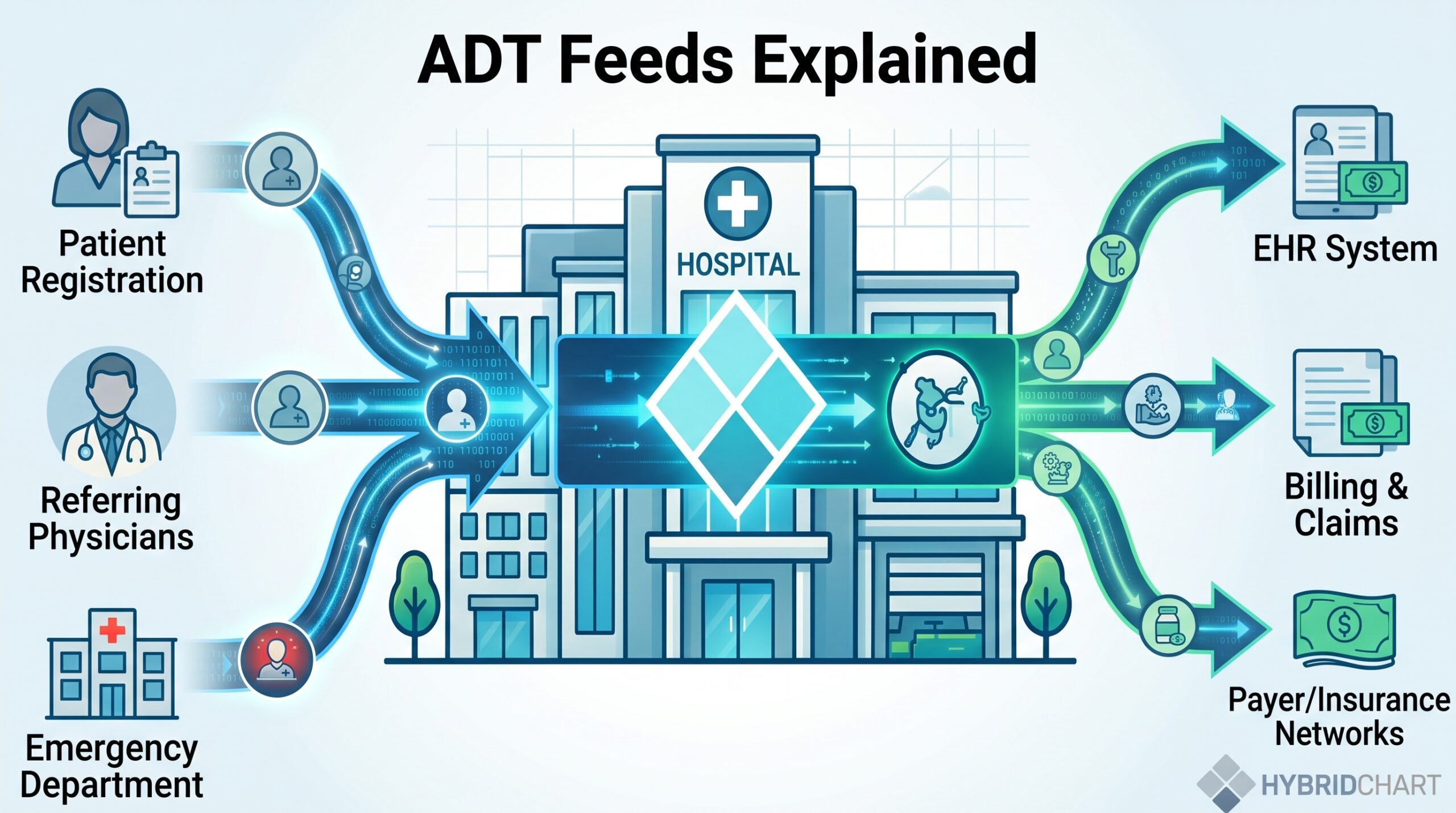
An ADT feed automatically sends patient admission, discharge, and transfer data from the hospital to a connected system like HybridChart. This keeps a physician’s rounding list current without manual data entry.
- ADT feeds transmit admission, discharge, and transfer data automatically from the hospital.
- HybridChart EVOLVE uses ADT feeds to keep patient census data current in real time.
- This removes the need for manual entry of patient demographics during rounding.
- HybridChart connects to leading EHRs and hospital systems, including athenahealth, Epic, Cerner, and MEDITECH.
What is an ADT feed, and why does it matter for hospital rounding?
ADT stands for Admission, Discharge, and Transfer. An ADT feed is a data connection that automatically sends this information from a hospital’s system to a connected platform, so patient status updates without anyone manually re-entering it.
For hospital rounding, this means a physician’s census updates automatically as patients are admitted, discharged, or moved between units, rather than depending on a manual daily list.
What does ADT stand for in a hospital data feed?
ADT stands for Admission, Discharge, and Transfer, referring to the patient status data these feeds transmit automatically.
How does HybridChart use ADT feeds to support charge capture?
HybridChart EVOLVE receives ADT feeds directly from a hospital’s system, so patient demographics flow automatically into a physician’s census. This is what allows Census Management to reflect a real-time, accurate patient list across every facility a physician rounds in.
Without this feed, a rounding app would depend on manual entry every time a patient was admitted, transferred, or discharged, reintroducing the same delay and error risk that mobile charge capture is meant to eliminate.
Does HybridChart require manual entry of patient demographics for hospital rounds?
No. HybridChart EVOLVE‘s ADT feeds bring patient demographics in automatically from the hospital’s system.
Which systems does HybridChart’s ADT integration connect to?
HybridChart connects to the leading EHRs and hospital systems, including athenahealth, Epic, Cerner, and MEDITECH, with EHR connections typically activated within 1 to 2 business days.
This broad compatibility is what allows practices to adopt real-time ADT data regardless of which hospital system they round in.
Which EHR and hospital systems support ADT feed integration with HybridChart?
HybridChart integrates with athenahealth, Epic, Cerner, and MEDITECH, with ADT connections typically activated within 1 to 2 business days.
How does HybridChart EVOLVE compare to manual rounding sheets and generic EHR apps?
The table below compares the three approaches practices typically choose between for capturing charges during hospital rounds.
| Capability | Manual Rounding Sheets | Generic EHR Mobile Apps | HybridChart EVOLVE |
|---|---|---|---|
| Charge capture location | Recorded on paper, entered later | Built for office visits, not bedside hospital rounding | Captured at the bedside in 3 seconds |
| Charge lag | 3 to 7 day industry-standard lag | Not designed for real-time inpatient capture | Eliminated at the point of capture |
| Multi-facility visibility | No real-time visibility across facilities | Tied to a single practice’s EHR instance | Real-time census across every facility a physician rounds in |
| Revenue impact | 3 to 5 percent annual revenue loss (industry standard) | Revenue leakage from inpatient workflow gaps | Customers report 10 to 15 percent revenue gains post-adoption |
Key Takeaway: Real-Time Data Without Manual Entry
ADT feeds are what allow HybridChart EVOLVE‘s Census Management to stay accurate in real time. Patient demographics flow automatically from the hospital, connecting to athenahealth, Epic, Cerner, and MEDITECH.
See how HybridChart’s ADT feed integration can keep your rounding census current.