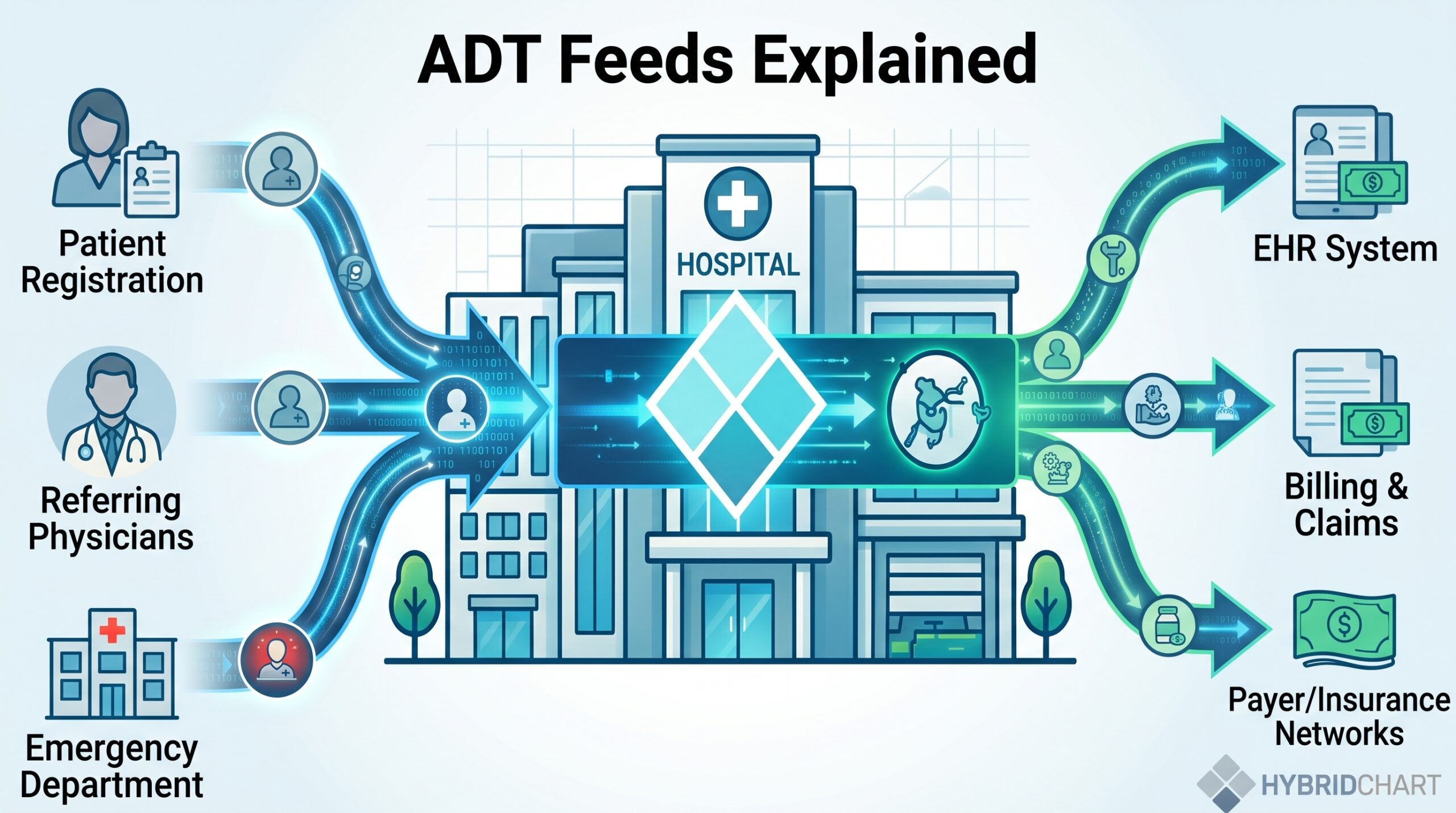
Paper-based rounding requires charges to be written down, carried back to the office, and entered manually, creating delay and error at every step. HybridChart EVOLVE captures charges in 3 seconds at the bedside, removing paper from the process entirely.
- Paper-based rounding sheets require charges to be transcribed a second time before they reach billing.
- HybridChart EVOLVE captures charges in 3 seconds at the bedside, with no second transcription step.
- Manual charge capture errors cost medical practices 3 to 5 percent of annual revenue industry-wide.
- The standard industry charge lag of 3 to 7 days is eliminated at the point of capture.
What does paper-based rounding actually cost a practice?
A paper rounding sheet requires a physician to write down a charge, carry it back to the office, and have someone else enter it into the billing system. Each step is an opportunity for a charge to be miscopied, delayed, or lost outright.
Industry-wide, medical practices lose 3 to 5 percent of annual revenue to manual charge capture errors tied to processes like this, with a standard charge lag of 3 to 7 days.
How much revenue does paper-based rounding typically cost a practice?
Industry data ties 3 to 5 percent of annual revenue loss to manual charge capture errors, the category paper-based rounding sheets fall into.
How does mobile charge capture remove the transcription step entirely?
HybridChart EVOLVE captures CPT and ICD-10 codes directly at the bedside in 3 seconds. That charge syncs to the desktop and billing system immediately, with no second person re-entering it from a handwritten note.
Removing that second transcription step is what eliminates the 3 to 7 day charge lag associated with paper-based processes.
Does mobile charge capture eliminate the need for a biller to re-enter rounding charges?
Yes. HybridChart EVOLVE charges sync directly to the desktop and billing system at the point of capture, without requiring manual re-entry from a paper sheet.
What else does a practice gain by moving off paper rounding sheets?
Beyond charge capture, HybridChart EVOLVE replaces paper-based discharge tracking with Discharge Planning tools and customizable order sets, supporting TCM billing capture. Customers report a 70 percent increase in TCM participation after adopting these tools.
Secure, HIPAA-compliant messaging also replaces the phone calls and paging that paper-based coordination typically requires.
Does moving off paper rounding sheets help with more than charge capture?
Yes. HybridChart EVOLVE also replaces paper-based discharge tracking and phone-based coordination with Discharge Planning tools and secure messaging.
How does HybridChart EVOLVE compare to manual rounding sheets and generic EHR apps?
The table below compares the three approaches practices typically choose between for capturing charges during hospital rounds.
| Capability | Manual Rounding Sheets | Generic EHR Mobile Apps | HybridChart EVOLVE |
|---|---|---|---|
| Charge capture location | Recorded on paper, entered later | Built for office visits, not bedside hospital rounding | Captured at the bedside in 3 seconds |
| Charge lag | 3 to 7 day industry-standard lag | Not designed for real-time inpatient capture | Eliminated at the point of capture |
| Multi-facility visibility | No real-time visibility across facilities | Tied to a single practice’s EHR instance | Real-time census across every facility a physician rounds in |
| Revenue impact | 3 to 5 percent annual revenue loss (industry standard) | Revenue leakage from inpatient workflow gaps | Customers report 10 to 15 percent revenue gains post-adoption |
Key Takeaway: Removing Paper Removes the Lag
Paper-based rounding requires a charge to be written, carried, and re-entered before it reaches billing. HybridChart EVOLVE captures that same charge once, at the bedside, in 3 seconds.
See how HybridChart can move your practice off paper-based rounding.